
Are You Focusing on the Audiences That Matter Most?
Posted on November 10, 2026
This article is part of a series exploring important topics presented in Communica’s 2027 Marketing Intelligence Report. To request a copy of the full report, contact Lauren Keifer at lkeifer@thinkcommunica.com.
A Three-Tier Framework for Smarter Audience Segmentation
Most organizations already segment their audiences. They group people by geography, age, industry, company size, job title, donor level or another characteristic that makes a large market easier to manage.
These categories are useful, but they only tell part of the story. They tell you who your audiences are, but not necessarily how they behave, what they need or how much value they bring to your organization.
Today, organizations have access to more behavioral and first-party data than ever before. Audiences also move across channels and interact with organizations in increasingly different ways. That creates an opportunity to segment audiences based not just on who they are, but on their current value, potential and behavior.
At Communica, we believe a better starting point is to ask: Which audiences matter most today, which have the greatest potential for growth and which could become more important in the future?
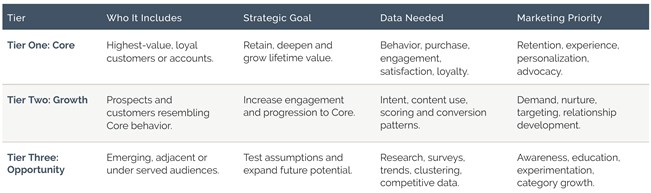

The Three-Tier Audience Architecture
To help our clients plan around audience behavior, evidence and potential value, we created Communica’s Three-Tier Audience Architecture, which organizes audiences into three strategic groups: Core, Growth and Opportunity. The framework helps leaders balance near-term value, efficient expansion and longer-term potential while setting clear priorities among audiences.
This distinction matters because most organizations have limited time, budget and capacity. When every segment becomes a priority, none receives the investment required to produce meaningful results. A tiered architecture creates focus while preserving room to test new possibilities.
Tier One: Core Audiences
Core audiences are the customers, accounts, donors, members, or patients that create the strongest current value. They may purchase repeatedly, stay longer, refer others, engage more deeply or align especially well with the organization’s mission and capabilities.

Consider a B2B technology firm applying the framework across its audiences. Its Core audiences might include established accounts with strong retention, expansion potential and strategic fit. Studying why these accounts renew, expand and refer others can reveal the specific value, service and relationship factors that strengthen loyalty.
Core audiences deserve a dual focus on retention and learning. These relationships often provide the richest first-party insight into why people choose the organization, what creates value and what strengthens loyalty over time.
Tier Two: Growth Audiences
Growth audiences show signs of fit and have room to develop greater relationship value. They may resemble Core audiences in behavior, needs or potential, or demonstrate intent through content use, inquiries, participation, product adoption or other meaningful signals.

For the B2B technology firm, Growth audiences might include prospects that resemble its strongest accounts, existing customers using only part of its offering or contacts showing meaningful intent through content use and inquiries. Relevant education, stronger proof and well-timed outreach can help move these relationships forward.
The goals are to understand what helps a Growth audience progress, identify the barrier preventing the next step, then shape the communication, experience or offer around that specific need.
Tier Three: Opportunity Audiences
Opportunity audiences are emerging, adjacent or underserved groups that may create future value. They can reveal new markets, unmet needs, changing behaviors or mission-aligned possibilities that the current strategy does not fully address.

These audiences deserve attention and disciplined testing. Because the fit is less established, organizations should manage Opportunity audiences as a portfolio of hypotheses and increase investment as evidence develops.
Back to our B2B technology firm. Opportunity audiences might include companies in an adjacent industry or a new type of buyer whose needs align with the firm's capabilities but remain unproven. Interviews, small pilots and behavioral data can help determine whether these possibilities warrant greater investment.
The priority is disciplined learning, not immediate scale. Set clear criteria for what would justify greater investment, then expand when the evidence shows meaningful need, fit and potential value.
Allocate Investment Intentionally Across the Tiers
The three-tier model sets a foundation for deliberate allocation, with different levels of investment across the groups. Core audiences usually provide the strongest current value and the most reliable insight. Growth audiences often offer the most efficient expansion. Opportunity audiences can create important future value and require more testing and patience.
The right allocation depends on the organization’s economics, mission, maturity and growth goals. An established organization seeking efficient growth may emphasize Core and Growth. A new venture or expanding nonprofit may reserve more capacity for Opportunity testing. The important decision is intentionality: leaders should know what each tier is expected to contribute and how success will be evaluated.
One of the most common mistakes is overfunding speculative opportunity while underinvesting in audiences already demonstrating trust and fit. New audiences can feel more exciting than familiar ones. But durable growth often begins by understanding why the best existing relationships work—and using that insight to find and serve more people with similar needs.
Build Segments Around Behavior and Evidence
The three tiers become more useful when behavior and first-party data complement demographic or firmographic information. Purchase patterns, engagement, retention, service interactions, content use, participation and expressed needs often reveal more than surface characteristics.
AI-assisted analysis can help identify combinations that manual review might miss. Because machine-generated clusters still require validation, we like to compare every segment against real outcomes such as conversion, retention, satisfaction, lifetime value, mission impact or relationship strength. Human judgment remains essential to deciding whether a pattern matters.
A useful audience architecture evolves with the market. As behavior changes and better information becomes available, organizations can refine the tiers, test assumptions and update priorities.
A Practical Audience Architecture Audit
Here’s a plan we use with our clients that may work for you. Set aside 60 minutes with the people who know your audiences best—typically marketing, sales, service, fundraising or program leaders. Bring your current segment list, recent engagement data and examples of active campaigns. Create a simple worksheet with one row for each audience and columns for evidence, value, needs, tier and next action.
1. Gather the evidence. For each audience, record what you actually know from purchases, inquiries, website behavior, event attendance, email engagement, interviews, surveys or service interactions. Mark any characteristic based mainly on history or internal opinion as an assumption to validate.
2. Identify the value created. Choose two or three indicators that matter to your organization, such as revenue, purchase frequency, retention, referrals, donations, etc. Note which audiences consistently produce the strongest results.
3. Document what the audience needs next. Write down the decision each audience is trying to make, the main barrier slowing progress and the information or experience that would help. Use this to identify the next useful communication, offer or improvement.
4. Assign the tier. Place proven, high-value audiences in Core; audiences showing credible signs of fit or intent in Growth; and emerging groups that still require testing in Opportunity. If the evidence is weak, label the assignment provisional and identify what you need to learn.
Compare the completed worksheet with your current spending, content and staff attention. Then choose one action for each tier: strengthen a Core relationship, create a clearer path for a Growth audience and define a small test for an Opportunity audience. Assign an owner and a 90-day deadline to each action.
At the end of the audit, you should have three practical outputs: a tiered audience list, one priority action for each tier and a short list of information gaps to close. Review these quarterly so audience priorities evolve with new evidence rather than remaining fixed by habit.
What This Means for Leaders
Audience architecture is ultimately a resource-allocation discipline. It helps organizations protect valuable relationships, pursue growth with greater precision and test new possibilities to gather evidence before making larger investments.
The best audience strategies begin with a simple reality check: are we focusing on the people who matter most, based on what their behavior and our results are telling us? A clear, manageable set of segments helps teams decide which relationships to deepen, which audiences to grow and which new opportunities are worth exploring.
Ready to take a closer look at your audiences?
Start with the 60-minute audience architecture audit outlined above, or talk with the Communica team about how a clearer view of your audiences can help inform your marketing priorities, investment and growth strategy.